
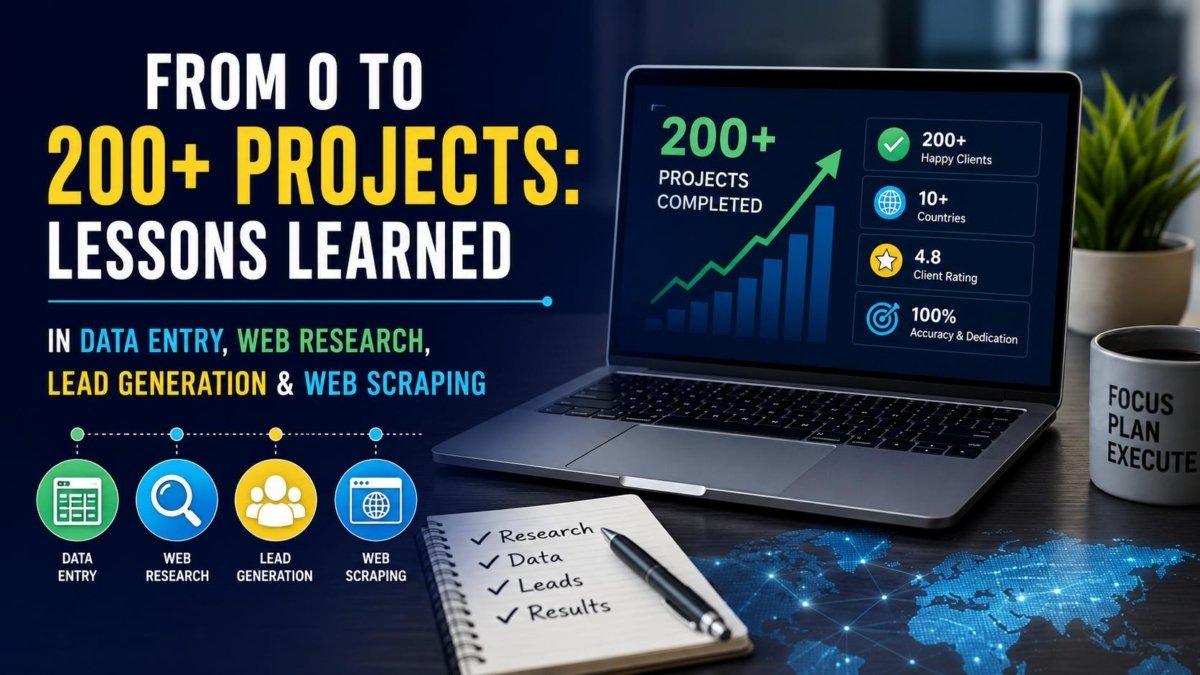
When I began freelancing in 2021(started providing services, such as data entry, web research, lead generation & web scraping), I had no clients, no reviews, and no track record. All I had was a computer, a strong work ethic, a BSCS degree from the University of Sargodha, and a real passion for working with data.
Fast forward to today, and I’ve completed over 200 projects for international clients in the USA, UK, Canada, Europe, Australia, and many other countries. I’ve built databases of more than 40,000 business locations, scraped over 15,000 law firm records from an entire country, created targeted B2B lead lists for cold outreach campaigns, and conducted extensive internet research for technology executives and startup founders.
The journey from having nothing to completing over 200 projects taught me more about data, business, and client relationships than I ever expected. In this article, I want to share the key lessons I learned so that other freelancers, businesses, and anyone interested in understanding the real world of data and lead generation can benefit from my experience.
Starting From Zero, The Hardest Part
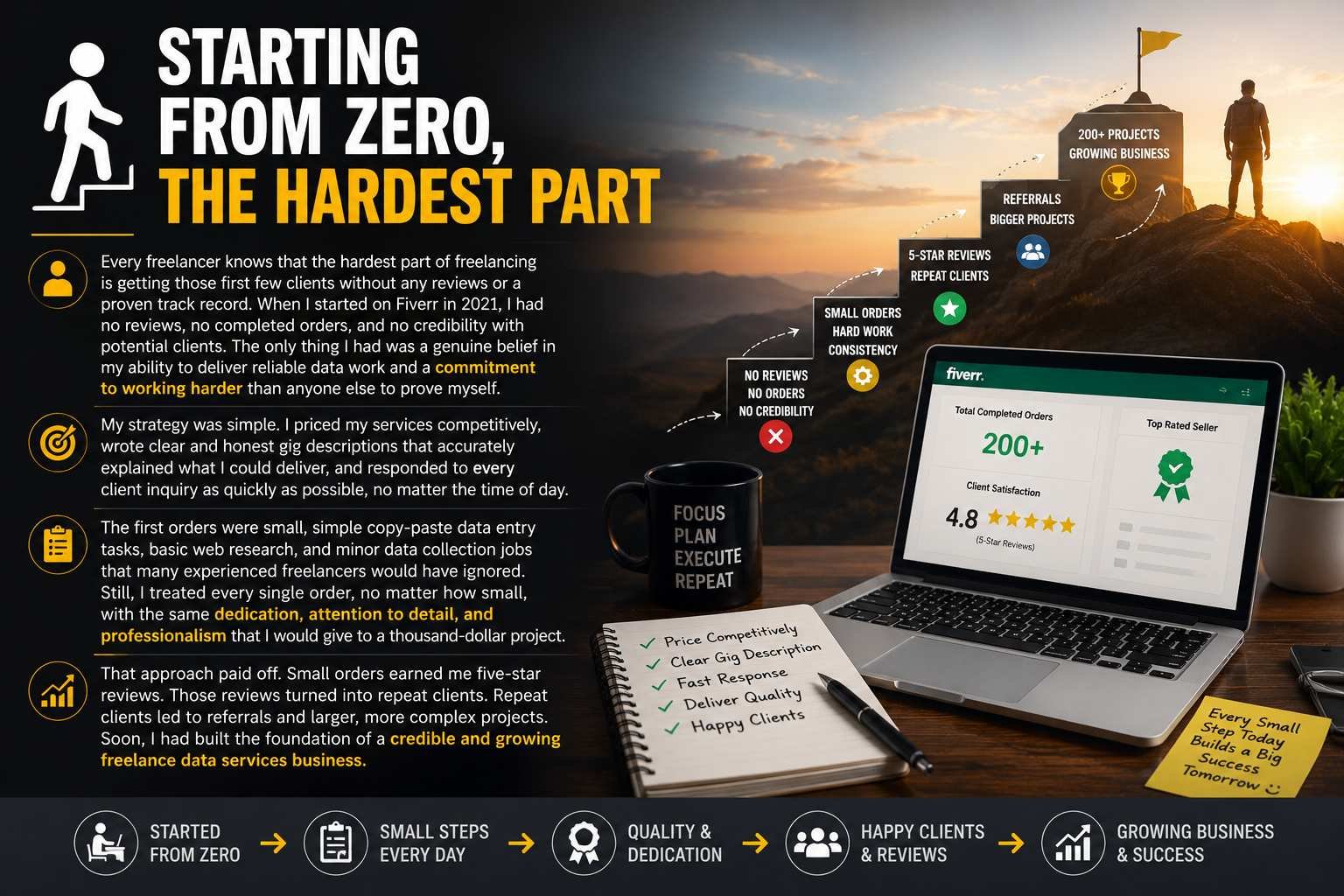
Every freelancer knows that the hardest part of freelancing is getting those first few clients without any reviews or a proven track record. When I started on Fiverr in 2021, I had no reviews, no completed orders, and no credibility with potential clients. The only thing I had was a genuine belief in my ability to deliver reliable data work and a commitment to working harder than anyone else to prove myself.
My strategy was simple. I priced my services competitively, wrote clear and honest gig descriptions that accurately explained what I could deliver, and responded to every client inquiry as quickly as possible, no matter the time of day.
The first orders were small, simple copy-paste data entry tasks, basic web research, and minor data collection jobs that many experienced freelancers would have ignored. Still, I treated every single order, no matter how small, with the same dedication, attention to detail, and professionalism that I would give to a thousand-dollar project.
That approach paid off. Small orders earned me five-star reviews. Those reviews turned into repeat clients. Repeat clients led to referrals and larger, more complex projects. Soon, I had built the foundation of a credible and growing freelance data services business.
Lesson 1: Quality Always Wins Over Speed
The first important lesson I learned in my first year of freelancing was that quality always beats speed in the data services industry. Many freelancers make the mistake of rushing through projects to finish them quickly and move on to the next order. This leads to errors, missing fields, formatting issues, and unhappy clients who leave negative reviews and won’t return.
I took a different approach from day one. I always prioritized accuracy and completeness over speed. I double-checked every record, verified every email address, confirmed every phone number, and quality-checked every dataset before delivery, no matter how long it took.
US businesses, in particular, focus heavily on data quality. They pay for accurate and verified data that they can immediately use in outreach campaigns, sales processes, and business operations. If your data is wrong, incomplete, or poorly formatted, it costs them time, money, and opportunities.
Delivering consistently high-quality data has built my reputation faster than anything else and is the single biggest reason I grew from zero to over 200 completed projects with a 4.8-star rating on Fiverr.
Lesson 2: US Businesses Have Very Specific Data Requirements
One of the most valuable things I learned early in my career(data entry, web research, web scraping, & lead generation) is that US businesses have very specific data requirements that differ from those of clients in other parts of the world. American clients are usually precise about what data fields they need, in what format, and how the data should be organized. They expect professional delivery, clean formatting, and immediate usability without extra processing or cleaning.
Working with US businesses taught me the importance of asking detailed questions before starting any project to understand precisely what the client needs. What specific data fields are required? What format should the data be in? What geographic area needs coverage? What is the intended use of the data? Are there specific sources to use or avoid?
Taking the time to fully grasp the client’s requirements before starting work avoids misunderstandings, reduces revisions, and leads to faster delivery, happier clients, and better reviews.
One memorable lesson came from a logistics client in the USA who needed retail store location data across all 50 US states. He needed more than just names and addresses; he needed precise latitude and longitude coordinates for every location so his delivery routing software could calculate optimal routes. If I hadn’t asked the right questions up front and delivered only standard address data without coordinates, the dataset would have been useless for his needs.
That project eventually grew into one of my largest completed orders, with over 40,000 retail store locations scraped and delivered across the US. It taught me that understanding the client’s specific needs and delivering exactly what they require, rather than a generic version, makes the difference between a satisfied client and an exceptional one.
Lesson 3: The Right Data Changes Businesses
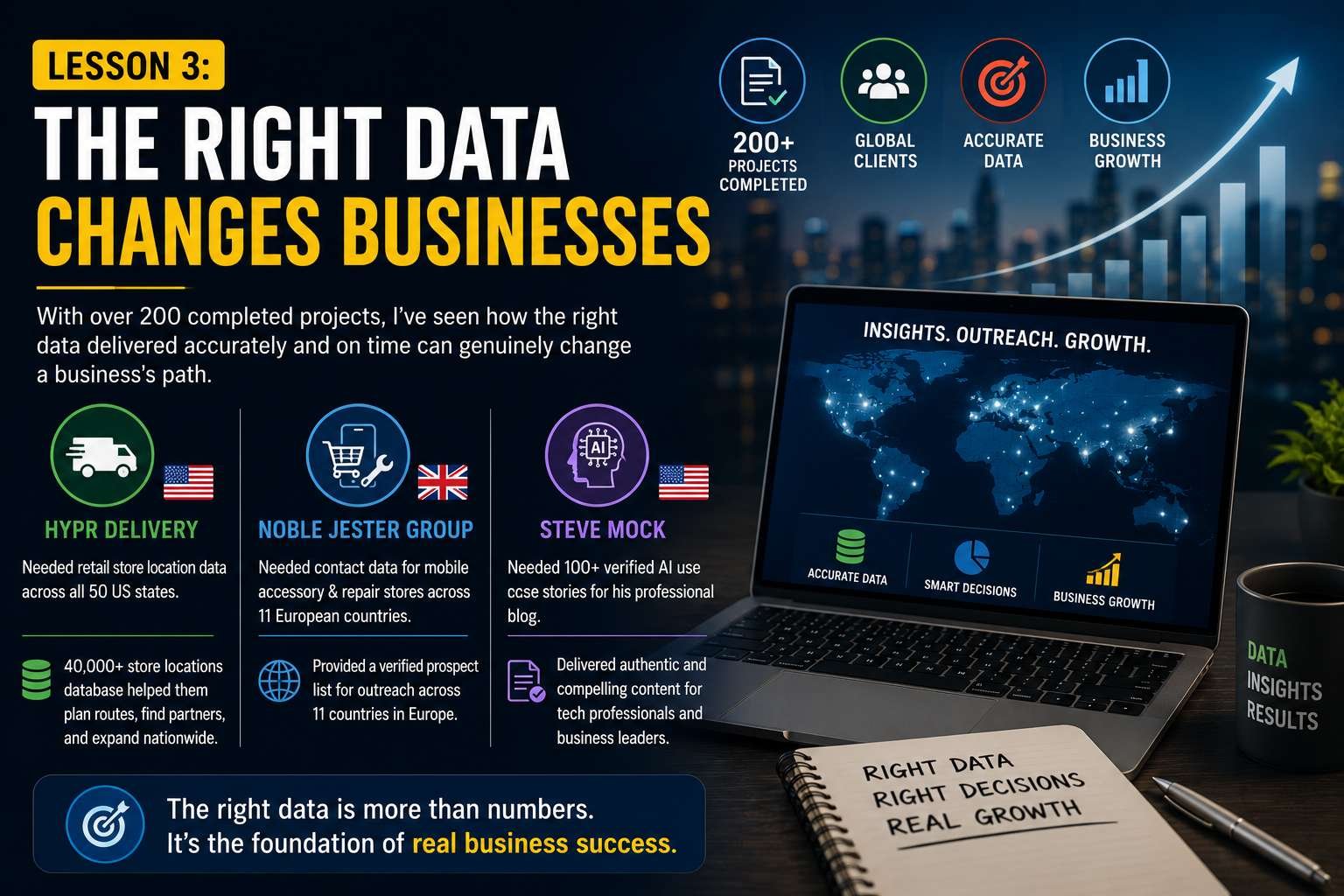
With over 200 completed projects in(data entry, web research, web scraping, & lead generation), I’ve seen how the right data delivered accurately and on time can genuinely change a business’s path.
I worked with a same-day delivery and logistics startup called Hypr Delivery that needed comprehensive retail store location data across all 50 US states to expand their network and find potential partners. The 40,000+ store location database we created gave their team the geographic information they needed to plan delivery routes, identify underserved markets, and reach out to potential partners nationwide.
I collaborated with a UK sales agency called Noble Jester Group that needed detailed contact data for mobile phone accessory and electronics repair stores across 11 European countries to support their market expansion strategy. The database we built provided their sales team with a verified prospect list for outreach campaigns across Germany, Ireland, Switzerland, France, Finland, Denmark, Sweden, Austria, Spain, Belgium, and Estonia.
I assisted a technology executive in the USA named Steve Mock, who needed over 100 verified AI use case stories from public online platforms for his professional blog. The extensive research project we completed provided him with authentic and compelling content that resonated with his audience of tech professionals and business leaders.
In each of these cases, the data we delivered was more than just a spreadsheet. It was a tool that enabled real business decisions, outreach campaigns, and growth.
Lesson 4: Cold Outreach Data Needs to Be Verified, Not Just Collected
One of the biggest mistakes I see businesses make with cold outreach campaigns is using unverified data. They collect thousands of email addresses and phone numbers from various online sources, then send mass outreach messages without checking if the contact information is valid, current, and attributed to the right person.
The results are always the same: high email bounce rates, low response rates, tarnished sender reputation, wasted time and money, and no new business generated.
From delivering over 200 data projects, I learned that verification is just as important as collection in any data or lead generation project. Every email address needs verification before entering a cold outreach campaign. Every phone number must be checked. Every decision-maker’s name and job title must be confirmed against current LinkedIn profiles and company websites.
This verification process takes extra time and effort, but cold outreach campaigns need to achieve the results that clients expect. At PreciseDataWorks, we include manual verification and quality checks as a standard part of every data and lead generation project. We never send a dataset to a client without first confirming its accuracy and completeness because we know that the quality of our data directly affects the success of our clients’ outreach campaigns.
Lesson 5: Every Industry Has Different Data Needs
Throughout my work(data entry, web research, web scraping, & lead generation) on over 200+ projects with clients in more than 15 industries, including retail, healthcare, legal, real estate, SaaS, marketing, sales, sports, logistics, technology, finance, and non-profit, I learned a valuable lesson: each industry has unique data needs, sources, and quality standards.
Real estate clients require agent names, license numbers, brokerage details, geographic coverage areas, and contact information from platforms like Zillow and Redfin. Healthcare clients need clinic names, practitioner types, specialties, addresses, phone numbers, and email addresses from medical directories and Google Maps. Legal clients want law firm names, practice areas, attorney information, addresses, phone numbers, and reviews from legal directories and Google Maps. SaaS and technology firms seek company names, funding details, technology stack information, decision-maker names, and verified email addresses from LinkedIn and company databases. Sports and fitness clients need coach profiles, certification details, specialties, and contact information from coaching directories and certification body websites.
By understanding the specific data needs, quality standards, and preferred sources for each industry, I became significantly more effective in delivering high-quality results for clients in every niche.
Lesson 6: Relationships Matter More Than Transactions
When I began freelancing, I viewed each project as a transaction: the client pays, I deliver data, and the project is done. Then I would move on to the next order.
Over time, I realized that the most successful and profitable client relationships are built on genuine communication, consistent quality, and a deep understanding of the client’s business goals, not just their immediate project needs.
Many of my best clients started with a small, one-time data entry or web scraping project. These small projects grew into long-term relationships where they regularly bring new and larger work because they trust the quality of my work and my reliability.
For instance, Ed O’Riordan, a Senior Investor Manager at Amazon Web Services in Ireland who runs The Week in Irish Startups newsletter on Substack, needed active job listings from the Irish startup ecosystem for his newsletter. This project required more than data collection; it required understanding the Irish startup scene and knowing what information would be most valuable to his subscribers.
Josh Sutchar, Head of Sales at Farren and co-founder of TrainHeroic, needed a complete coach database from various international sports coaching directories to support Farren’s mission of connecting everyday athletes with top coaches. This project needed thorough research across multiple countries, languages, and platforms, along with techniques to find verified email addresses and social media profiles for coaches not publicly listed.
Both projects went far beyond simple data collection. They required genuine engagement with the client’s goals and a solid commitment to delivering data that would truly advance their business.
Lesson 7: Manual Research and Automation Both Have Their Place
A common misconception about web scraping and data collection is that automation tools can do everything faster and better than manual research. In reality, the most effective and accurate data collection combines automated and manual methods based on each project’s specific needs.
Automated web scraping tools work well for collecting large amounts of structured data from consistent and well-organized online sources like Google Maps, business directories, and listing platforms. They can gather thousands of records much faster than doing it manually, making them essential for large-scale data projects.
However, manual research is necessary for complex data needs that require human judgment and verification. Finding a specific decision maker’s personal email, confirming that a business is still operating, verifying that a LinkedIn profile belongs to the right person, or extracting data from a complex website all require manual effort and expertise that no automated tool can fully replicate. The combination of automation for scale and manual research for accuracy ensures that PreciseDataWorks consistently delivers high-quality, verified data to clients across various industries worldwide.
Lesson 8: Free Samples Build Trust Faster Than Anything Else
One of the most effective practices I implemented early in my freelancing career was to offer a free sample for every project before the client committed to the full order. This approach works well because it eliminates the biggest barrier international clients face when hiring a freelancer for the first time: trust. They don’t know you personally, they can’t meet you, and they are being asked to send money based solely on your profile and a few reviews.
Offering a free sample instantly removes that barrier. It shows the client exactly what your data looks like, proves the quality and accuracy of your work, and assures them that you can deliver what they need before they invest in the full project. Every client I’ve given a free sample to has appreciated this approach. It shows confidence in my work, a real commitment to client satisfaction, and creates the trust that turns first-time clients into long-term business.
What the Next Chapter Looks Like
After completing over 200 projects and handling more than 140 Fiverr orders with a 4.8-star rating for clients in the USA, UK, Canada, Europe, Australia, New Zealand, Ireland, Germany, France, the Netherlands, and many more, I am more passionate about data and lead generation services than ever.
The demand for accurate, verified, and targeted data is rising as more businesses invest in cold outreach, sales automation, and data-driven marketing strategies. They need reliable data specialists who can consistently deliver accurate results on time.
PreciseDataWorks is now expanding beyond Fiverr with this professional website to serve international clients directly, offering more comprehensive data entry, web scraping, lead generation, internet research, and data management services.
Whether you need a quick data entry task or a large-scale web scraping and lead generation project delivered over several weeks, we are open for hire worldwide. We take on short-term, long-term, and permanent data projects starting from $15 per hour, with a free sample available for every project.
Conclusion
My journey from zero to over 200+ completed projects has taught me that success in data entry, web research, data scraping, and lead generation boils down to a few fundamental principles that remain the same, no matter the project size or client industry.
Quality always prevails. Verified data produces real results. Understanding a client’s specific needs is more important than just finishing a task. Building real relationships adds more value than chasing transactions. Offering a free sample builds trust faster than any marketing message can.
If your business needs accurate data, verified lead lists, or comprehensive web scraping services from a proven specialist with a solid track record, contact PreciseDataWorks today.
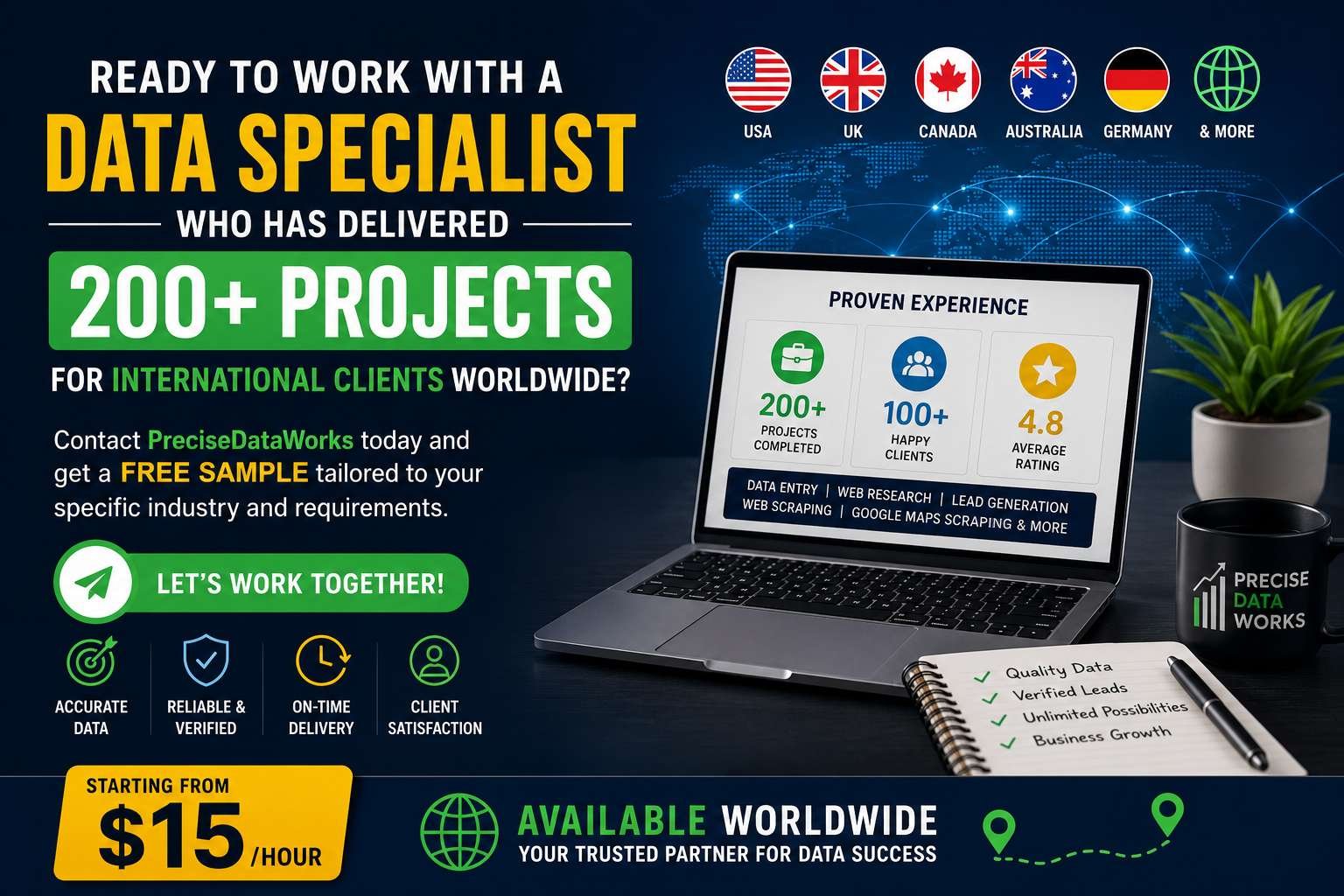
Ready to work with a data specialist who has delivered 200+ projects for international clients worldwide? Contact PreciseDataWorks today and get a free sample tailored to your specific industry and requirements. Available worldwide. Starting from $15/hour.
📧 alkaramnawaz92@gmail.com
📱 WhatsApp: +923071001421